MILITARY GARDENS: Roberto Burle Marx in Brasília
Catherine Seavitt
Apr 30, 2026
(6pm)
Talk
Free; RSVP required
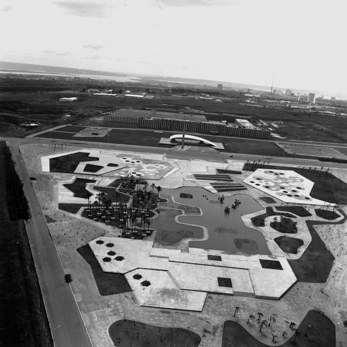
In this lecture, Catherine Seavitt explores two often overlooked episodes in the career of Roberto Burle Marx (1909–94): his absence from the original planning of Brasília in 1960 and his later association with Brazil’s military dictatorship through service on the Conselho Federal de Cultura. Seavitt argues that any discussion of Burle Marx and Brasília must take these histories into account. She considers, in particular, his later work for the military government in Brasília, including two ministry palace gardens and Praça dos Cristais, the large triangular plaza at army headquarters created with architect Oscar Niemeyer. Commissioned in 1967 as a military parade ground and inaugurated in 1973, Praça dos Cristais reveals the political context in which Burle Marx’s late work in the capital took shape.
The talk draws on Seavitt's book Depositions: Roberto Burle Marx and Public Landscapes under Dictatorship (University of Texas Press, 2023), supported by a grant from the Graham Foundation, and is presented in conjunction with Latinitudes: A Collection of Latin American Modern Architecture.
Catherine Seavitt is Meyerson Professor and Chair of the Department of Landscape Architecture at the University of Pennsylvania’s Stuart Weitzman School of Design. She is the faculty codirector of the McHarg Center for Urbanism and Ecology and creative director of the department’s LA+ Journal. A registered architect and landscape architect, she is a fellow of the American Society of Landscape Architects, the American Institute of Architects, the Council of Educators in Landscape Architecture, and the American Academy in Rome. Her research explores urban landscapes, post-industrial sites, toxicity, and inventive plant knowledge, with a focus on actionable responses to the climate crisis and decarbonization. Seavitt’s books include Depositions: Roberto Burle Marx and Public Landscapes under Dictatorship (University of Texas Press, 2023); Structures of Coastal Resilience, with Guy Nordenson and Julia Chapman (Island Press, 2018); and Four Corridors, with Guy Nordenson and Paul Lewis (Hatje Cantz, 2019).
Image: Roberto Burle Marx, aerial view of the Crystal Plaza garden for the Ministry of the Army with Oscar Niemeyer's Army Headquarters complex seen beyond, 1972, Brasília, Brazil. Courtesy of the Arquivo Público do Distrito Federal.
For more information on the exhibition, Latinitudes
A Collection of Latin American Modern Architecture, click here.

Architecture of Noise
Nile Greenberg, 2025–26 Douglas A. Garofalo Fellow
Apr 23, 2026
(6pm)
Talk
Free; RSVP required
Nile Greenberg presents Architecture of Noise, his research as the 2025–26 Douglas A. Garofalo Fellow at the University of Illinois Chicago (UIC) School of Architecture. Greenberg asserts that the present is a battery—that we preside over a time of noise, not signal and noise, not the noise of the past, but a gesamtkunstwerk of noise: every inch authored by someone.
Through projects and research developed at UIC, he examines how architecture can operate within overlapping crises—environmental, economic, and political—where control is often dispersed across many actors and systems. Architecture must author and reauthor its contexts and sites, remake the present, and confront its responsibilities and its risks. Greenberg positions this as a call for architecture to recalibrate itself within crisis, within noise, and within its history.
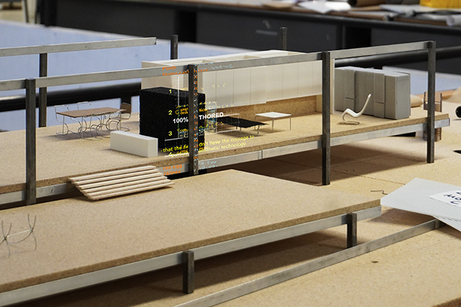
This talk follows the exhibition of Architecture of Noise at the Edith Farnsworth House (April 19–20), which brings together a series of projects: a film; a reimagined history of Chicago; a survey of sites shaped by environmental and economic forces; a visual survey of Chicago architecture; and a new masterplan for the Farnsworth House. Part of the exhibition, including Illuminated Archive and the film 100% Authored, will be on view in the Graham Foundation's third-floor gallery in conjunction with the talk.
Related Exhibition:
The Edith Farnsworth House, 14520 River Rd, Plano, IL 60545
Free admission. No registration required. Check in at the visitors center.
Opening: Sunday, April 19, 4–6 p.m.
Open House: Monday, April 20, 2–6 p.m.
Nile Greenberg is a founding partner of Abel Nile New York. Abel Nile New York guest edited the 2025 issue of Flash Art Volumes on the theme of Crisis Formalism—a dossier of architectural responses to re-integrate architectural form and crisis. Greenberg serves as architecture editor at The Brooklyn Rail, overseeing a section that focuses on the relationship between architecture and art. His published works include coauthoring The Advanced School of Collective Feeling (Park Books, 2023), a study on the relationship between physical culture and housing in the 1920 and curating the exhibition Two Sides of the Border at Yale. Greenberg is the 2025-26 Douglas A. Garofalo Fellow at University of Illinois Chicago. He has taught at University of Illinois Chicago; Columbia University Graduate School of Architecture, Planning and Preservation (GSAPP); and Cornell University College of Architecture, Art, and Planning (AAP). His work has been presented at the 19th International Architecture Exhibition. La Biennale di Venezia, Venice; Midway Contemporary Art, Minneapolis; ETH Zürich, Zurich; Spazio Maiocchi, Milan; Center for Architecture, New York; Rice University, Houston; Harvard University Graduate School of Design, Cambridge; University of Melbourne, Melbourne; and The Cooper Union, New York Greenberg was recognized as New Practices New York 2020-23 by American Institute of Architects, New York (AIANY).
About the Douglas A. Garofalo Fellowship
Named in honor of architect and educator Doug Garofalo (1958–2011), this nine-month teaching fellowship provides emerging designers the opportunity to teach studio and seminar courses in the undergraduate and graduate programs and conduct independent design research. The fellowship also includes a public lecture at the Graham Foundation and an exhibition at the University of Illinois at Chicago (UIC) School of Architecture. To learn more about the fellowship, click here.
Note: This event will be held in the ballroom on the third floor of the Madlener House, which is only accessible by stairs. The first-floor galleries and bookshop are accessible via outdoor lift. Please contact us at 312.787.4071 or info@grahamfoundation.org to make arrangements.
Image: Architecture of Noise (model), 2026. Photo: Nile Greenberg
Kari Watson — SOLD OUT
Lampo Performance Series
Apr 18, 2026
(7pm)
Performance
Limited capacity — SOLD OUT
This event is sold out. Due to limited capacity, no additional tickets are available. We appreciate your interest and hope to see you at a future event.
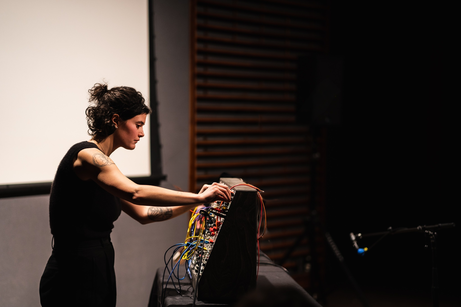
Kari Watson premieres Fuse, a new solo performance for analog modular synthesizers and programmed drum machines. The piece plays with clock function and tempo ramps, moving between analog and digital environments as Watson shapes the sound in real time.
Fuse engages a quadraphonic speaker array in tandem with a spatial audio sculpture of unhoused speaker cones distributed through the room. A custom synth garment—made in collaboration with visual artist and designer Av Grannan—houses patch cables and an XLR snake that tie Watson’s body into the setup. Modular instruments sit atop custom ceramic tables made with visual artist and ceramicist Paige Schlosser, designed so cables can be woven in and around the surfaces.
Watson takes theorist Donna Haraway’s cyborg as an origin point for the project: a figure of synthesis and hybridity, where humans and machines are enmeshed and the boundaries between body and environment are continually unsettled. Fuse makes that unsettled boundary audible, asking where the performer ends and the surrounding system begins.
Kari Watson (b.1998, Philadelphia, Pa.) is a composer, performer, and intermedia artist working across contemporary concert music, electroacoustic composition, live performance, and installation. As a performer on analog synthesizers, Watson integrates custom spatialization systems built in Max/MSP with multi-speaker arrays, foregrounding tactility and drama in spatial sound.
Watson’s work has been presented at Darmstädter Ferienkurse, Darmstadt; Donaueschinger Musiktage, Donaueschingen; MINU Festival for Expanded Music, Copenhagen; Les Écoles d’Art Américaines de Fontainebleau, Fontainebleau; the Composers Now Dialogues Series; Ravinia Festival’s Breaking Barriers Festival; and Frequency Festival, Chicago, among others. Additional presentations have taken place at KM28 and Richten25, Berlin; The Horse Hospital and IKLECTIK Art Lab, London; Werkstatt für Improvisierte Musik Zürich; Khimaira, Stockholm; the Chicago Cultural Center; and the International Museum of Surgical Science.
Collaborators include Jennifer Torrence, Maya Bennardo, Sarah Saviet, Yarn/Wire, Collective Lovemusic, Eduard Teregulov, Ensemble Dal Niente, TAK Ensemble, MIVOS Quartet, Line Upon Line, and Quatuor Diotima. Recent projects have also been presented through Roulette; Experimental Sound Studio; and International Anthem’s 11×11 Series with Katinka Kleijn.
Recordings include enclosures (Sawyer Editions, 2025) and VISTAS, with Katinka Kleijn (Elektramusic, 2025). Watson received the 2023 Kranichstein Music Prize for Composition from the Darmstädter Ferienkurse and a 2022 Charles Ives Scholarship from the American Academy of Arts and Letters. Watson is currently a Ph.D. candidate in music at the University of Chicago.
Photo: Eduard Teregulov
Art After Hours
EXPO CHICAGO
Apr 10, 2026
(12pm)
No registration required
Friday, April 10, 12–8 p.m.
As part of EXPO ART WEEK, the Graham Foundation galleries and bookshop will be open late on Friday, April 10, with extended hours until 8 p.m. to explore Latinitudes: A Collection of Latin American Modern Architecture, with photographs by Leonardo Finotti and curated by Michelle Jean de Castro.
Click here to explore the EXPO ART WEEK guide and discover galleries and institutions participating across the city.
Italian Journeys
Andrea Bagnato in conversation with Jennifer Scappettone
Apr 07, 2026
(6pm)
Talk
Free; RSVP required
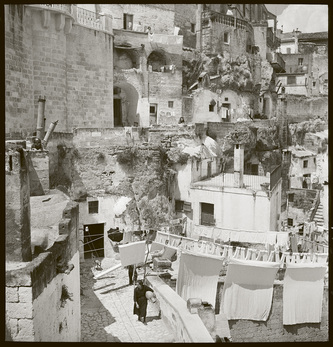
In Terra Infecta, Andrea Bagnato traces a political ecology of the Italian landscape. The book, recently published by MACK, uses the lens of health and illness to explore how the modern quest for sanitation shaped Italy's urban and rural landscapes through architecture, demolition, and displacement. The result of a decade of research and fieldwork supported in part by a grant from the Graham Foundation, Terra Infecta recounts histories of dispossession and resistance in Naples, Venice, Milan, and Matera.
Andrea Bagnato is joined by Jennifer Scappettone for a reading and conversation. Drawing from their respective research and writing, Bagnato and Scappettone discuss the long-term markings that fascism, internal colonialism, and modernization have left on the physical environment, and how different narrative forms can help us make sense of ecological change.
Andrea Bagnato is an architect and writer based in Genoa, Italy. He has taught at Piet Zwart Institute, Rotterdam; the Architectural Association School of Architecture (AA), London; and the Decolonizing Architecture program at the Royal Institute of Art, Stockholm. Previous books include the collective volumes Rights of Future Generations (Hatje Cantz, 2022) and the Graham-funded A Moving Border: Alpine Cartographies of Climate Change (Columbia, 2019).
Jennifer Scappettone works at the confluence of the literary, visual, and scholarly arts, and is professor of literature and faculty affiliate of the Committee on Environment, Geography, and Urbanization at the University of Chicago, where she directs the Environmental Arts+Humanities Lab. She is the author of five full-length books of poetry, translations and prose, including most recently Poetry After Barbarism, The Republic of Exit 43, and Killing the Moonlight: Modernism in Venice.
Presented with support from the Istituto Italiano di Cultura di Chicago.
Image: Marjory Collins, Life in Matera before the evictions, 1950. Photograph. Courtesy Schlesinger Library, Harvard Radcliffe Institute, Cambridge, MA

 PREVIOUS POSTS